
Independent and owner’s engineers keep telling us the same thing: the leading cause of module failure isn’t the panel itself. It’s how the panels are supported.
That finding is easy to miss, because support failures don’t announce themselves. A module that cracks under load doesn’t stop producing. It produces slightly less, then a little less again, across a 30-year asset life — and the loss shows up in a production report years after the truck left site.
The standard was written for a different module
For years, the industry standard has been to hold a module at a short span near its middle. That was a reasonable choice. Modules were smaller, frames were thicker, and a mid-span clamp pair put the support where the bending moment was highest.
Both of those conditions have changed.
Today’s modules are physically larger, and the frames holding them are thinner. A larger panel spans further between supports, and a thinner frame carries less of that span on its own. Under snow load or wind uplift, the glass and cells take a share of the work the frame used to do.
A mid-span-only support system was never designed for that. It isn’t a defective approach; it’s a solution to a problem that no longer looks the same.
What full module support changes
Our SOL-X Single Axis Tracker is engineered for full module support. Purlin width is customized to the module being installed, so every panel is fully supported regardless of its frame size, and each module is bolted at both ends. Modules are attached within the manufacturer’s approved clamping zone (the “green zone”), maximizing the supported area of every panel instead of holding it at a single short span in the middle.
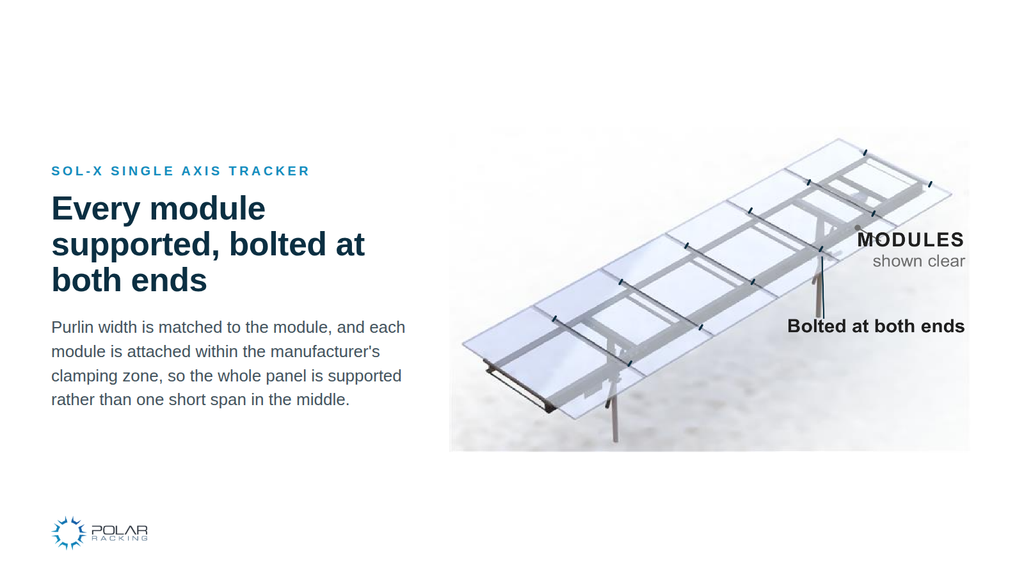
The practical consequence: load entering the module face is carried into the racking across the whole panel, rather than concentrating at one span. When the table is tilted into wind at operating angle, the panel stays supported along its full length.
Clamping is configurable. Where a project’s module or site loads call for it, we increase the number of clamping points per side rather than asking the module to make up the difference.
Three outcomes worth putting a number to
- Less micro-cracking, and more energy over the project’s life. Cracks initiated by repeated bending don’t fail a module outright; they degrade it. Reducing the bending reduces the degradation, over the full 30 to 40 year life of the project.
- Better warranty terms. Module manufacturers set warranty conditions partly on how their product is mounted. Complete module protection in high wind and heavy snow loads is a conversation you can have with a manufacturer, with structural calculations behind it.
- Lower O&M cost. Fewer broken modules means fewer truck rolls, fewer replacements, and less time spent diagnosing production shortfalls that trace back to the mounting system.
Why this belongs in your technical review
Racking is usually evaluated on cost per watt, install hours, and terrain tolerance. Those matter. But the mounting system also determines the mechanical environment your modules live in for four decades, and that consequence is rarely priced into the comparison.
Full module support isn’t a premium feature. For the modules being specified today, it’s the baseline those modules were designed to need.
Talk to sales. Send us your module and site loads and we’ll show you the support geometry: sales@polarracking.com